
The Real Cost of "We've Always Done It This Way"
The Invisible Tax on Your Growth
As a business grows, "the way we've always done it" stops being a foundation and starts becoming a ceiling. That happens to a five-person crew and to a fifty-person firm. For owners, manual process cost is often the largest single source of operational debt.
At this stage, you aren't just paying for the time it takes to click a button; you are paying for the opportunity cost of your highest-leverage talent acting as a "Human API" between disconnected systems.
How to Calculate Your Manual Process Cost
To eliminate operational waste, you must first quantify it. Most leadership teams underestimate the financial drain of manual workflows because they only look at the hourly rate of the person performing the task.
The true cost of a manual process is a multi-variable calculation.
The "Human API" Cost Formula
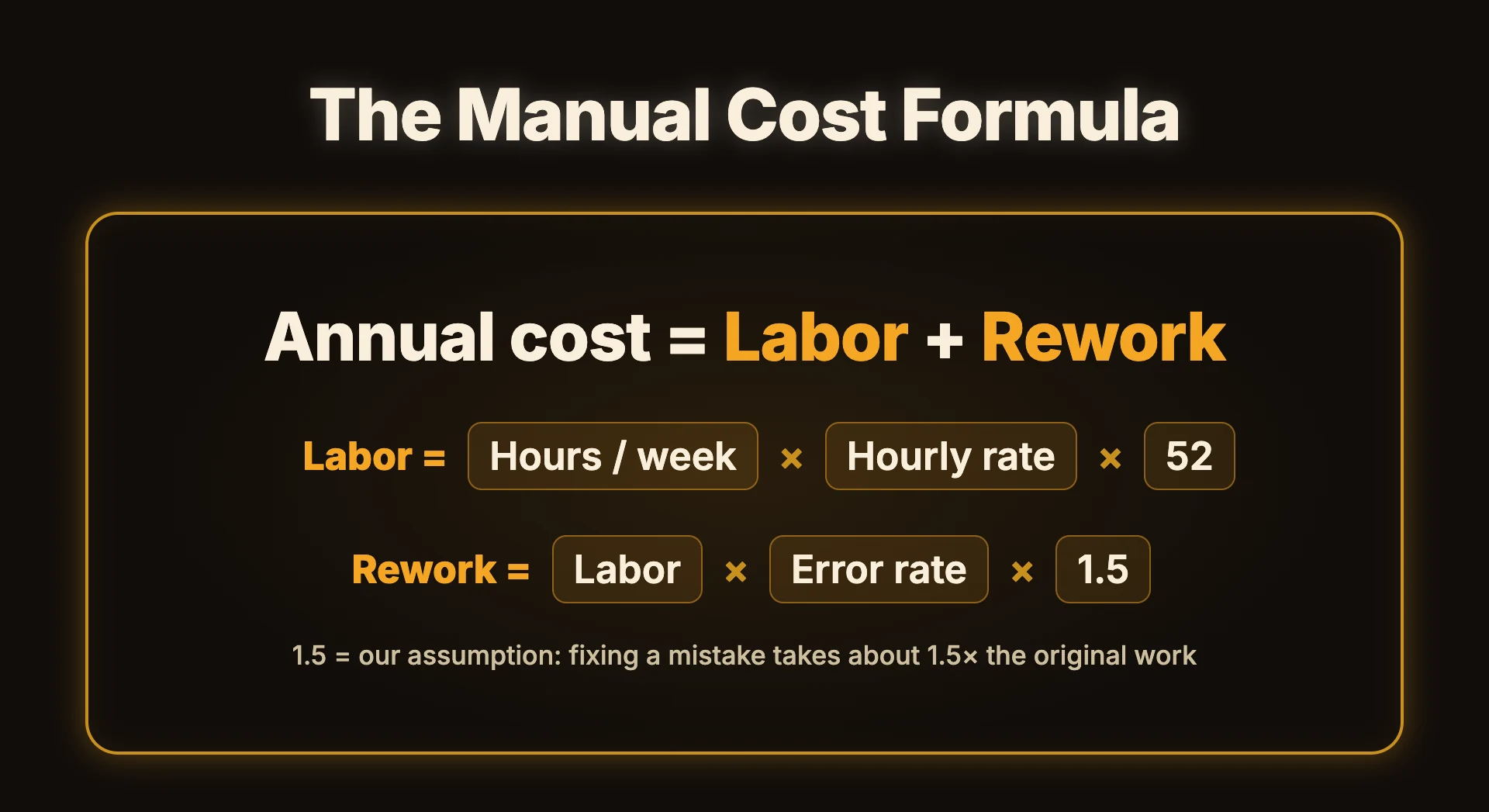
To get an accurate figure, apply this formula to any repetitive task. It is the same method our Manual Tax Calculator uses: Annual cost = Labor + Rework, where Labor = H × R × 52 and Rework = Labor × Error rate × 1.5.
- H: Hours per week spent on the manual task.
- R: Fully burdened hourly rate of the employee.
- 52: Weeks per year.
- Error rate: The share of runs that need fixing. The 1.5 is our planning assumption that fixing a mistake takes about one and a half times the original effort. It is not an industry benchmark; adjust it if you know your own.
Cost Comparison: Manual vs. Automated
Consider processing 100 records per month. Manual entry requires 12 hours of labor a month at $50/hr: $7,200 a year in labor, plus about $430 in rework at a 4% error rate, so roughly $7,600. An automated integration handles the same volume with about half an hour of monitoring a month and almost no errors, about $300 a year in labor, plus the cost of the tool. Manual costs scale linearly: double the work, double the cost. Automation costs remain flat. For the full return once you count tool and maintenance costs, see Automation ROI: What It Actually Looks Like.
The Three Pillars of Operational Waste
To achieve business process optimization, you must identify where the "tool sprawl" is creating friction. In our operations consulting practice, we see three primary buckets of waste.
1. Data Fragmentation (The "Silo" Tax)
When your CRM doesn't talk to your Project Management tool, and your PM tool doesn't talk to your Billing software, your team becomes the bridge. This tool sprawl creates "Data Silos."
The Risk: Leadership makes decisions based on 3-week-old data because the "Real-Time" dashboard requires a manual export/import process to update.
The Solution: Systems integration using middleware like Make or Zapier to create a single source of truth.
2. The Talent De-Leveraging Trap
Picture an operations manager you hired for their judgment who spends two days a week formatting CSV files. That is a costly misallocation of talent.
The Risk: High-performers reach "process fatigue." They stop looking for ways to grow the business because they are too busy keeping the existing engine from overheating.
The Solution: Implement workflow automation for all "Level 1" administrative tasks (data entry, status updates, basic reporting).
3. The Error Compound Effect
A manual error in a spreadsheet doesn't stay in the spreadsheet. It flows into your financial forecasting, your customer billing, and your resource planning.
The Risk: Revenue leakage. Companies that reconcile billing by hand quietly lose money through missed entries and unapplied credits, and nobody notices until someone audits it. On the receivables side, How to Reduce AR Aging Without Hiring Anyone covers the fix.
Solving Operational Chaos: A 3-Step Framework
If you are ready to move past "the way we've always done it," follow this process improvement hierarchy.
Phase 1: Tool Consolidation
Before you automate, simplify. Most growing businesses pay for software they barely use. Identify where features overlap and cut the bloat. You cannot automate a mess; you must first define the stack.
Phase 2: Workflow Mapping
Document the "Happy Path" for every core business function, from lead ingestion to final invoice. If a human has to move a piece of data from Point A to Point B, it is a candidate for automation. What Should You Automate First? shows how to pick which candidate goes first.
Phase 3: Automation, With AI Where It Fits
Move beyond simple "If-This-Then-That" logic. Modern AI automation can now handle unstructured data (reading PDFs, summarizing client calls, even triaging support tickets), tasks that previously required a human touch.
Modern Ops is the Competitive Edge
In a market where efficiency is the new growth, the ability to scale without adding headcount is your greatest competitive advantage. Reducing your manual process cost isn't just about saving money; it's about increasing the "velocity" of your entire organization.
Price your own process
The Manual Tax Calculator uses the same formula as this post. Enter how often a process runs, how long it takes and who does it, and get a yearly dollar figure in about two minutes.
Calculate Your Manual Process Cost