
The Tool Sprawl Trap: Why More Software Isn't the Answer
What Tool Sprawl Looks Like
In small-to-mid-size businesses, "Operational Debt" is often the silent killer of scale. It isn't just about bad processes; it's about the technical friction created by a bloated, disconnected tech stack. When a company hits the 20-employee mark, the default reaction to any bottleneck is to buy a SaaS solution. A few years of that and you are paying for dozens of subscriptions, several of which overlap.
This is tool sprawl. It's the result of solving symptoms rather than root causes. If your team is spending more time updating tools than doing the work those tools were meant to facilitate, you aren't running an efficient operation. You're managing a software museum. It is also one of five signs your operations are holding you back.
The Hidden Math of Tool Sprawl
The cost of a tool is never just the monthly "per seat" price. For an operator, the real cost of too many business tools is calculated through three specific drains on the organization. The first is the "Human Router" problem, where your people become the manual connective tissue between systems.

1. The Human Router Efficiency Gap
When data lives in silos, your most expensive assets, your people, become "human routers." They manually copy data from a lead form to a CRM, then from the CRM to a project management tool, then from there into a billing system. This isn't just a waste of talent; every manual hand-off is another chance for a typo, a skipped field or a step nobody remembered. If your data isn't moving via API, your team is acting as the middleware.
2. The Context-Switching Tax
Every application switch requires a cognitive "reload." For a manager overseeing a team of 10, the friction of checking three different platforms to get a status update isn't just annoying. It's a productivity floor. When you consolidate your stack, you don't just save on subscription fees; you reclaim the "deep work" hours that drive actual business growth.
3. Data Integrity Decay
Tool sprawl leads to "multiple versions of the truth." Marketing sees one set of numbers in HubSpot; Sales sees another in Pipedrive; Finance sees a third in QuickBooks. Without SaaS consolidation, you cannot achieve a "Single Source of Truth" (SSoT). Without an SSoT, your AI and automation efforts will fail because they are being fed fragmented, low-quality data.
Why "More Features" Often Means "Less Utility"
We are currently in the era of the "all-in-one" platform that actually isn't. Many companies buy a massive platform like Salesforce or Jira, then realize it's too complex for their specific needs, so they buy "point solutions" (like Calendly, Loom, or specialized Task Managers) to patch the gaps.
This creates a "Shadow Stack." You end up paying for the expensive enterprise platform and five smaller tools that do what the enterprise platform was supposed to do.
From an operations consulting perspective, the goal is to identify your System of Record (where the "truth" lives) and your Systems of Engagement (where the work happens). If a tool doesn't clearly fit into one of these categories or integrate seamlessly between them, it is operational noise.
The 3-Step Audit Framework for Radical Consolidation
To escape the trap, you need more than a spreadsheet; you need a mandate for simplicity. You need a structured framework to audit your stack and make decisive moves.
Step 1: The Technical & Financial Baseline
Don't ask your team what they use. Look at the data.
- Financial Audit: Export your last 12 months of credit card and ACH transactions. Tag every software vendor.
- The "Shadow IT" Scan: Use a tool or simply review browser extensions and SSO logs to find tools that aren't on the official budget.
- Utilization Metric: For every tool, pull the "Last Login" or "Monthly Active User" (MAU) report. Our rule of thumb: if a tool has less than 40% adoption across the seats you pay for, treat it as either poorly implemented or unnecessary.
Step 2: Mapping the Data Flow (The Integration Audit)
List your "Core Four" tools: usually your CRM, Project Management, Communication (Slack/Teams), and Finance platform. For every other tool in your stack, ask:
- Does it have a native integration or an open API? If it's a closed system that requires manual data entry, it is an operational liability.
- What is the "Data Overlap"? If Tool A and Tool B both store customer contact info, which one is the "Master"? If you can't answer that in five seconds, you have a data integrity problem.
- Can this function be handled by a "Core Four" tool? Often, you are paying for a standalone tool for a feature that already exists in a platform you already pay for.
Step 3: The "Cull and Automate" Execution
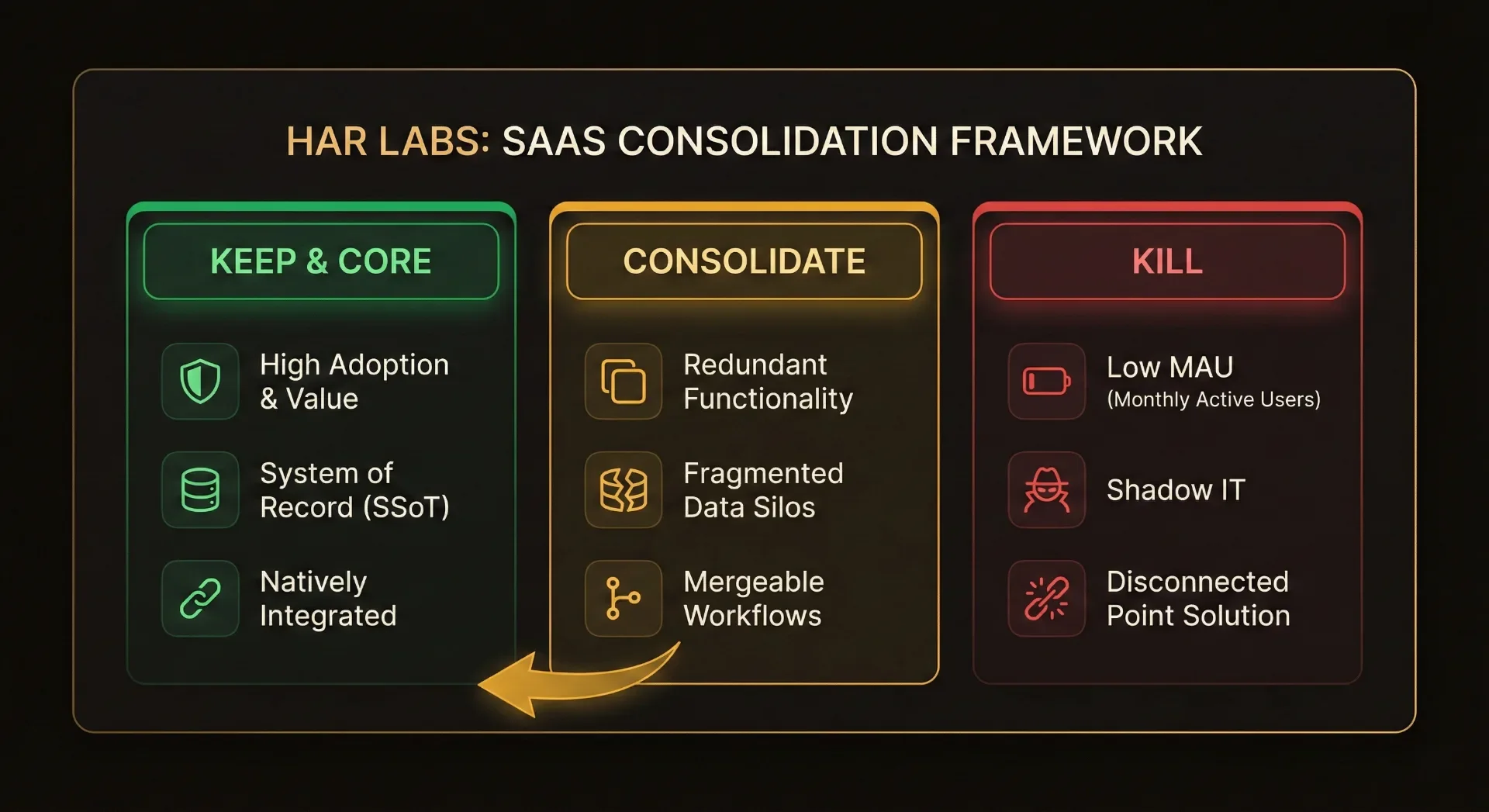
Once the audit is complete, categorize every tool into three buckets: Keep, Consolidate, or Kill.
- Kill: Any tool with low adoption or redundant functionality. Do not wait for the "perfect time" to migrate. The cost of the subscription is usually lower than the cost of the mental energy spent maintaining it.
- Consolidate: Move fragmented teams onto a single platform. If Marketing and Ops use different task managers, pick the one with the better API and force a migration. Standardized tools lead to standardized processes.
- Automate: For the tools that remain, build the "Connective Tissue." Use workflow automation (via Make, Zapier, or custom scripts) to ensure data flows one-way from the System of Engagement to the System of Record.
Free download · Excel / Google Sheets
Tool Stack Template
Run this audit in a spreadsheet that does the math for you: annual cost, adoption per tool, and a keep / consolidate / kill column.
The Result: A Lean Operational Engine
Once the stack is lean, decide what to automate first with the F × T × E scoring method, and put a dollar figure on each candidate with the Manual Tax Calculator.
The goal of business process optimization isn't to have the most sophisticated tech stack; it's to have the most invisible one. When your tools are consolidated and integrated, the software disappears, and the work takes center stage.
By eliminating tool sprawl, you reduce your overhead, improve your data quality and, most importantly, clear the path for automation, including AI where it fits. You cannot automate a mess. You must simplify, then integrate, then automate.
AI automation and high-level operations aren't about adding more "moving parts" to your business. They are about ensuring the parts you have are moving in the same direction.
Start with one tool
Pick the one tool that causes the most "where do I find that?" questions and check who actually uses it. If adoption is low and the data lives nowhere else, that is your first cut.
If you'd like a second pair of eyes on the whole stack, a free 30-minute call is usually enough to find the overlap.
Book a Free Discovery Call