
5 Signs Your Operations Are Holding You Back
The Invisible Ceiling on Your Growth
There is a specific, painful stage in the life of a business where the "hustle" that got you here starts to work against you. It can arrive at 5 people or at 50.
In the beginning, manual work was a badge of honor. You did whatever it took to close a lead, ship a product, or satisfy a client. But as you attempt scaling operations, that same "do-whatever-it-takes" mentality turns into a structural liability. You start to notice that adding more people doesn't actually result in more output; it just results in more meetings, more Slack messages, and more fires to put out.
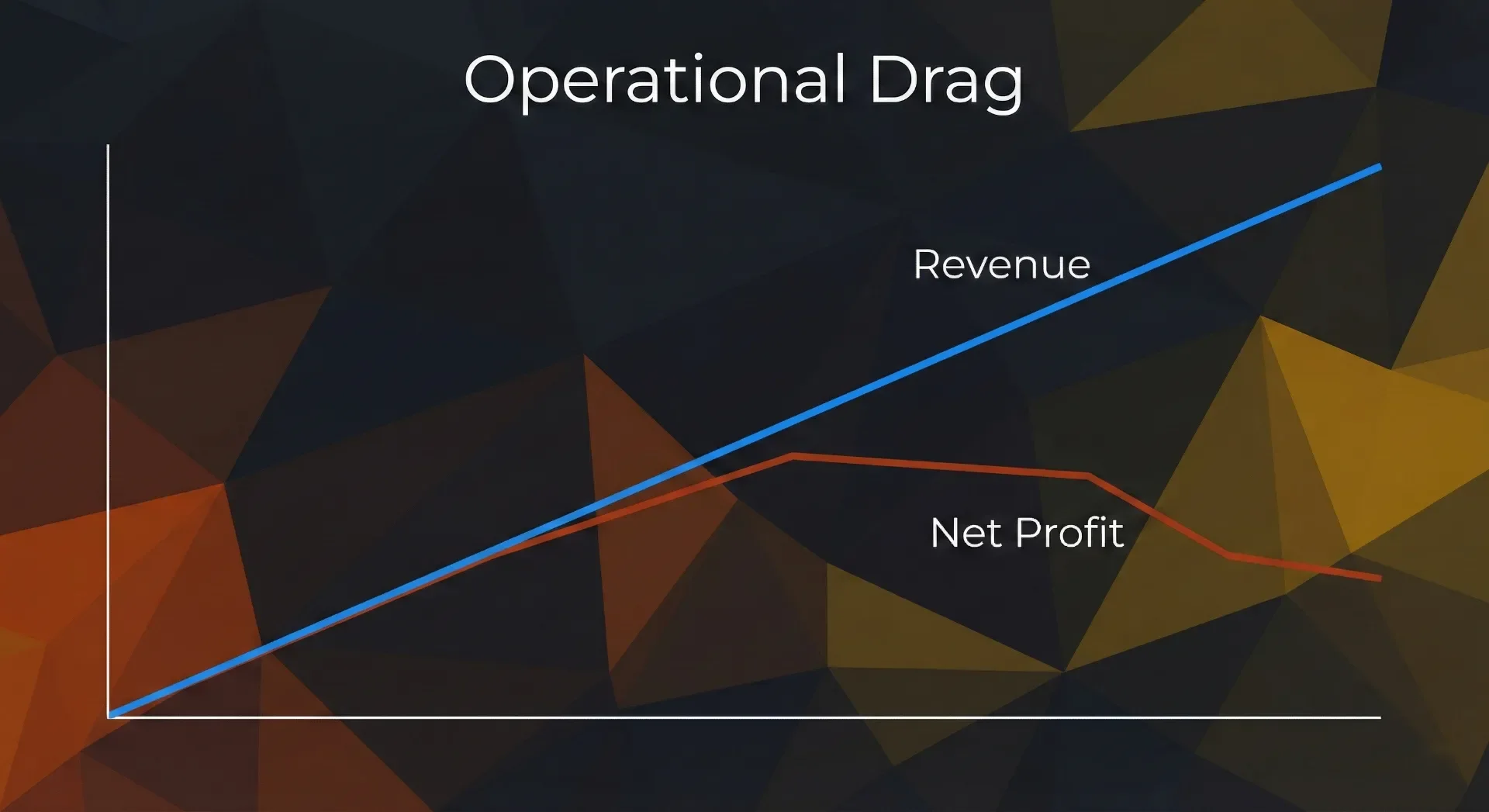
If you feel like you're running a marathon in waist-deep water, it isn't a lack of talent or market fit. It's an operations bottleneck. Your business has outgrown its "accidental architecture." The spreadsheets, the disconnected apps, and the tribal knowledge that served you at 10 people are now the very things holding you back at 50.
The owners we talk to are usually tired of their own internal friction more than of the market. Here are five signs that your operations have become a drag on your growth, and what to do about each one.
1. You Have "Human Middleware" (The Manual Data Loop)
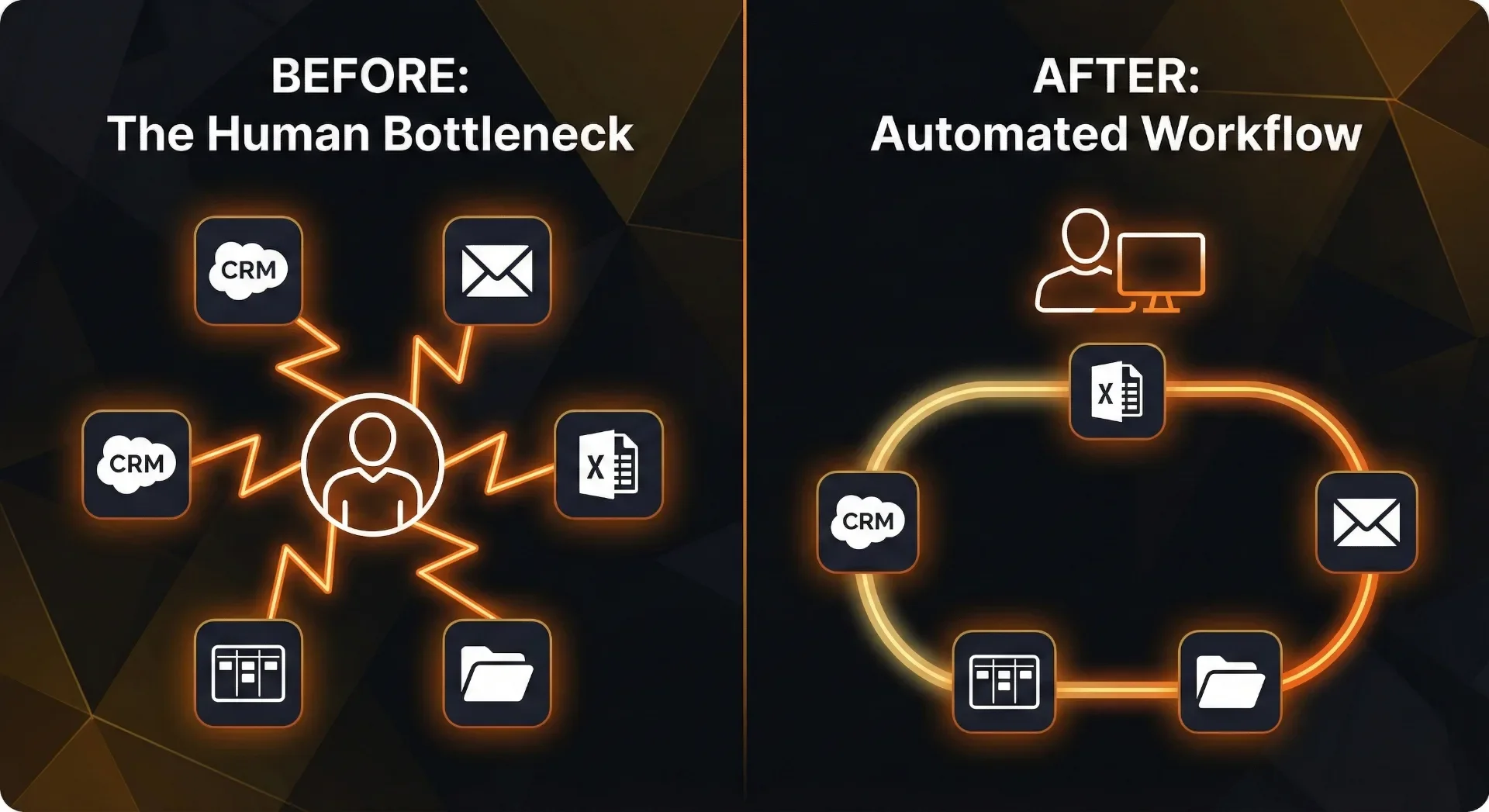
One of the clearest indicators of operational failure is when your most expensive employees spend significant portions of their day acting as a bridge between two pieces of software. We call this "Human Middleware."
If your team is manually exporting a CSV from your CRM to upload it into your project management tool, or if someone has to "remember" to ping the finance team in Slack every time a contract is signed, you have a manual process crisis.
What It Looks Like
Consider a professional services firm with 40 employees. Every time a new client is signed, an Account Executive manually sends an email to the Ops Manager. The Ops Manager then manually creates a folder in Google Drive, sets up a project in Monday.com, invites the client to a Slack channel, and alerts the billing department.
This takes 45 minutes of focused work. If you sign 10 clients a month, that's a full day of high-level management time wasted on clerical tasks. Beyond the time loss, the risk of a typo or a forgotten step is nearly 100%. When you try to scale this, the system breaks. The Ops Manager becomes the bottleneck, and the client's first impression is one of chaos.
The Fix
Workflow automation. By utilizing systems integration, the "Closed Won" trigger in your CRM should automatically execute every one of those steps. No manual entry, no forgotten folders, and no "Human Middleware."
One of our clients, Blue Shades Entertainment, had three people spending their days on scheduling confirmations, follow-up emails and status updates. Once that sequence ran on its own, those three people moved to client work. This is the first job we get hired for: connecting your systems so people stop carrying data between them.
2. You Pay for Tools That Don't Talk to Each Other
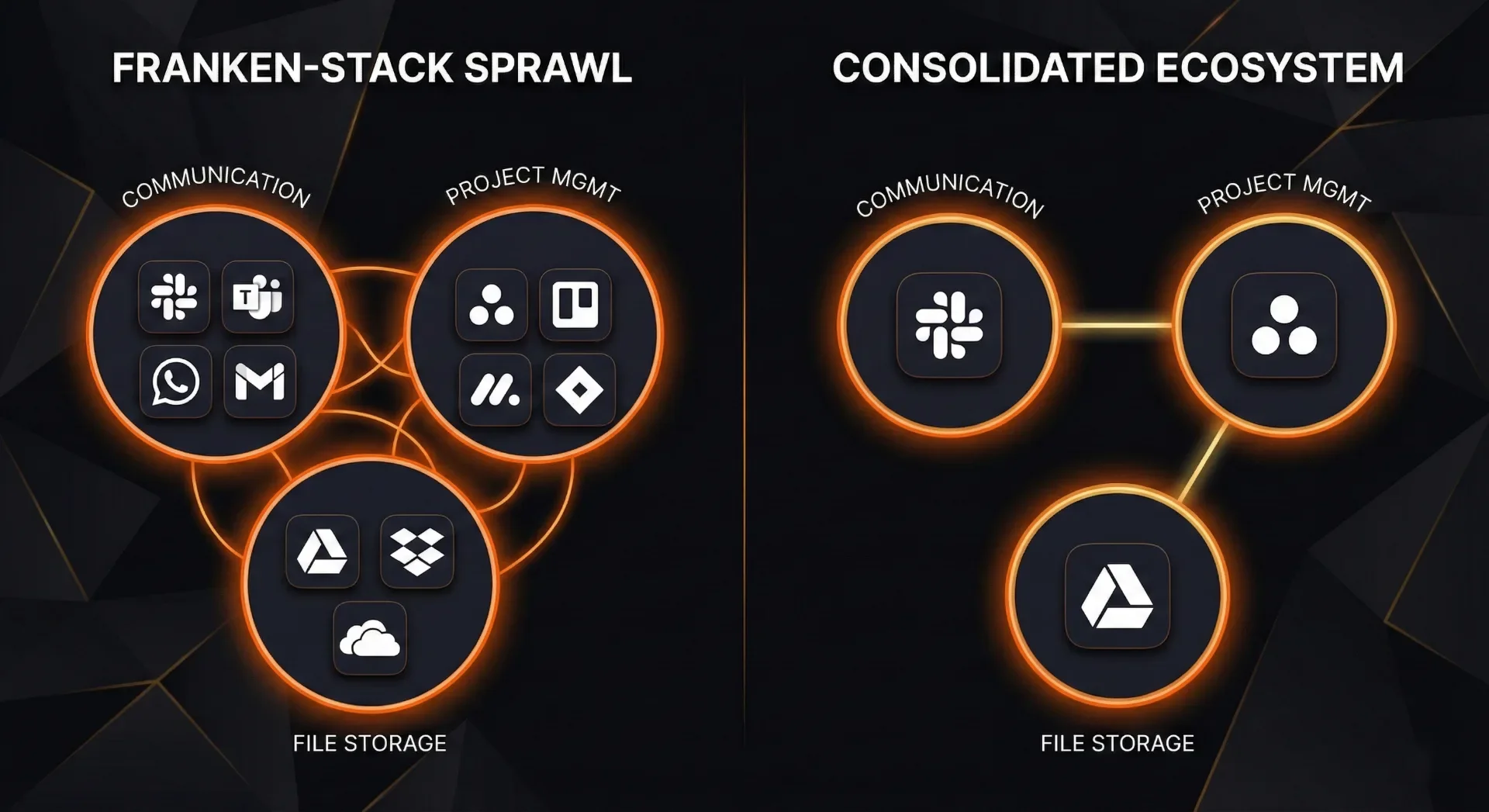
In the rush to solve immediate problems, most growing companies suffer from "accidental tool acquisition." Need to track tasks? Someone signs up for Trello. Need to store docs? Someone else starts a Notion page. Need to communicate? Everyone jumps into Slack.
Three years later, you have 30+ SaaS subscriptions, three of which do the exact same thing, and none of which talk to each other. This is tool sprawl. It doesn't just drain your budget; it drains your team's cognitive load.
What It Looks Like
A mid-sized marketing agency uses Slack for quick chats, Email for formal requests, WhatsApp for "emergencies," and Asana for project tracking. Because information is scattered across four different platforms, the "source of truth" is nonexistent.
When a project goes off the rails, the COO has to spend three hours "forensic auditing" these platforms to figure out what went wrong. The team is constantly context-switching, and critical client feedback is lost in a thread that half the team can't access. This lack of operational efficiency is why your margins are shrinking even as your revenue grows.
The Fix
Tool consolidation. You don't need a new app; you need a unified ecosystem. Audit your stack, kill the redundant tools, and ensure every remaining platform has a documented "Role in the Stack." We walk through the audit step by step in The Tool Sprawl Trap.
3. High-Growth, Declining Margins
This is the most dangerous sign because it's often hidden by top-line success. You're winning bigger contracts and hiring more people, but at the end of the quarter, the net profit hasn't moved, or worse, it's shrunk.
When your operations aren't optimized, growth becomes "expensive." You find yourself hiring "coordinators" just to manage the complexity created by your other employees. This is a classic operations bottleneck. You are throwing labor at a problem that requires a process.
What It Looks Like
An e-commerce brand scales from $2M to $10M in annual revenue. To handle the volume, they double their customer support team. However, because their inventory system doesn't sync with their shipping platform, the support team spends 60% of their time manually looking up tracking numbers for customers.
They are paying $500,000 a year in salaries for work that a $50/month API integration could do. Their cost to acquire and serve a customer is rising faster than their lifetime value. They are "scaling," but they are actually becoming less profitable with every sale.
The Fix
Business process optimization. Before you hire the next person, you must audit the workflow. If a task can be automated or a system can be integrated, do that first. Human capital should be reserved for high-leverage work, not fixing broken plumbing. What Should You Automate First? shows how to pick the first fix.
4. The "Status Update" Meeting Culture
If your calendar is a graveyard of 30-minute meetings labeled "Catch up on X" or "Status Update for Y," your operations are failing you.
Meetings are often a symptom of "Information Asymmetry." When people don't have a central dashboard or a clear process to see the status of a project, they resort to the only tool they have: asking someone else. If your managers spend more than 50% of their time in meetings "getting updated," they aren't managing. They're just retrieving data.
What It Looks Like
A software development shop has a daily "stand-up" that lasts 90 minutes. Why? Because the project management tool is so poorly maintained that no one knows what's actually being worked on. The developers have to manually explain their progress every single day.
This isn't collaboration; it's a manual reporting process disguised as a meeting. It kills morale and destroys the "deep work" required for technical excellence.
The Fix
Operational efficiency through transparency. When you have a single source of truth, automated through AI or better system design, the "status" of any project should be visible at a glance. Meetings should be for strategy and problem-solving, not for reading spreadsheets out loud.
Chris, the founder of Muskox, used to pull data from four different systems every Monday morning just to know where the business stood. Now Chris opens one dashboard. That is the reporting job in what we do: one view of the business that updates itself.
5. One Person Nobody Can Cover For
In many mid-sized businesses, there is a "Sarah" or a "Dave." Sarah is the only one who knows how the billing system actually works. Dave is the only one who knows how to onboard a specific type of complex client.
If Sarah or Dave goes on vacation, the business holds its breath. This "Hero Culture" is a massive red flag. It means your "process" isn't a process. It's a person. This is the ultimate bottleneck to scaling operations. You cannot grow a business that relies on the infinite availability and perfect memory of a few key individuals.
What It Looks Like
A founder-led consultancy is stuck at 15 people. The founder is involved in every single project because they are the only one who knows the "secret sauce" of how to deliver the work. They want to grow to 50 people, but they are physically and mentally at capacity.
Because the founder hasn't codified their expertise into a repeatable workflow or used operations consulting to build a scalable system, they have become the ceiling. The business cannot outgrow the founder's 24-hour day.
The Fix
Process design. You need to extract the "magic" from people's heads and build it into the system. This involves creating standard operating procedures (SOPs) and using automation to enforce those procedures so that the "system" handles the routine, and the "people" handle the exceptions. Finding those single points of failure is part of every operations diagnosis we run.
What to Fix First

Operational drag doesn't fix itself. In fact, it's one of the few things in business that reliably gets worse over time. Every new hire you add to a broken system increases the "complexity tax" your business pays. Every new tool you add to an unintegrated stack increases the "data fog" your leadership has to fight through.
The good news? These problems are solvable. They don't require "working harder." They require working differently.
By focusing on tool consolidation, workflow automation, and intentional business process optimization, you can shift your team's energy away from the "work about work" and back toward the activities that actually move the needle.
You built this business to grow. Don't let your back office be the reason it stops.
Which sign is costing you the most?
On a free 30-minute call we'll look at how work moves through your business, tell you which of these five is costing you the most, and what to fix first.
If it's something you can fix yourself this week, we'll say so.
Book a Free Discovery Call